
Song Premiere: Woody Guthrie, “Deportee (Woody’s Home Tape)”
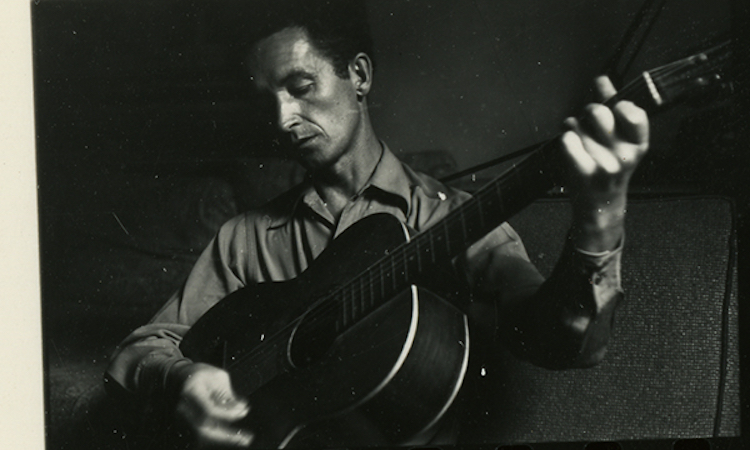
For generations, Woody Guthrie’s songs have homed in on fissures in our society, calling out politicians, demagogues, and others who eviscerate human rights, and identifying with disenfranchised individuals and groups. Guthrie’s indomitable spirit and his steely resolve produced forthright declarations of ongoing unfair labor practices, unjust and illegal actions toward immigrants, and the nefarious and insidious nature of fascism. With his guitar slung round his neck—the slogan “This Machine Fights Fascists” emblazoned on it—and his gravelly voice half-singing and half-narrating his songs, Guthrie wrote over 3,000 songs, leaving us with lyrics and music that enlivens our own current struggles and fights against unjust, immoral, and illegal political and cultural forces.
Woody Guthrie would have turned 113 today, and there’s no better way to celebrate his legacy than by hearing his never-before-released version of his iconic “Plane Wreck at Los Gatos (Deportee),” released today as “Deportee (Woody’s Home Tape).” Although the song has been recorded numerous times by artists ranging from Pete Seeger, Arlo Guthrie, Joan Baez, Bruce Springsteen, and Dolly Parton, among others, this version is his only known recording of it. Given the mass deportations of individuals in the United States in 2025, Guthrie’s song could easily be embraced as our national anthem of protest.
The song, of course, refers to the January 28, 1948, plane crash in California’s Los Gatos Canyon. No one survived the crash. On the plane were 28 Mexican workers whose names were left out the original news reports of the crash. Identifying with the workers, whom society had treated as nameless and faceless—the phrase “one more deportee” illustrates society’s tendency to dehumanize others by calling them by generic words rather than their names—Guthrie writes in the first person voice, urging listeners to identify themselves with these workers and to engage in protests or other humanitarian efforts to change the course of such heinous mistreatment of human beings.
Anna Canoni, Woody Guthrie’s granddaughter and President of Woody Guthrie Publications, points out that her grandfather wrote: “A song ain’t nothing but a conversation you can have again and again.” About this song she comments: “It keeps this conversation in the narrative. The song is the medium, but the conversation is what needs to be said, what needs to be had. And unfortunately, it needs to be had again and again and again. That’s what Woody’s lyrics remind us of—these larger life lessons, these conversations that must continue.”
“Deportee (Woody’s Home Tape)” will be included on Woody at Home—Volume 1 & 2 (Shamus Records), a collection of twenty-two previously unreleased tracks, including thirteen songs that Guthrie never recorded elsewhere. The collection includes previously unheard home recordings of “Biggest Thing That Man Has Ever Done,” “Pastures of Plenty,” and “Jesus Christ.” Guthrie recorded these songs himself into one microphone on a reel-to-reel tape machine at the Guthrie family’s two-bedroom apartment in Brooklyn, NY in the early months of 1951 and 1952.
As Canoni—who produced the album with Kathy Ostien and Steve Rosenthal—points out: “We are thrilled to finally share this private treasure trove of Woody Guthrie’s home recordings! These raw and intimate home tapes consist primarily of songs that Woody was unable to release in his lifetime, a life cut short by Huntington’s disease. Never intended for commercial release, these tapes were recorded as Woody’s introduction to his music publisher . . . . Woody’s gentle, matter-of-fact voice and sometimes out-of-tune guitar is a refreshing and humble reminder of the true power of song.” In these songs, she says, “Woody validates his own words, ‘I’ll use a song to tell the things that are right and the things that are wrong.’”
###
Pre-save Woody at Home—Volume 1 & 2 HERE.