Remembering Bob Weir
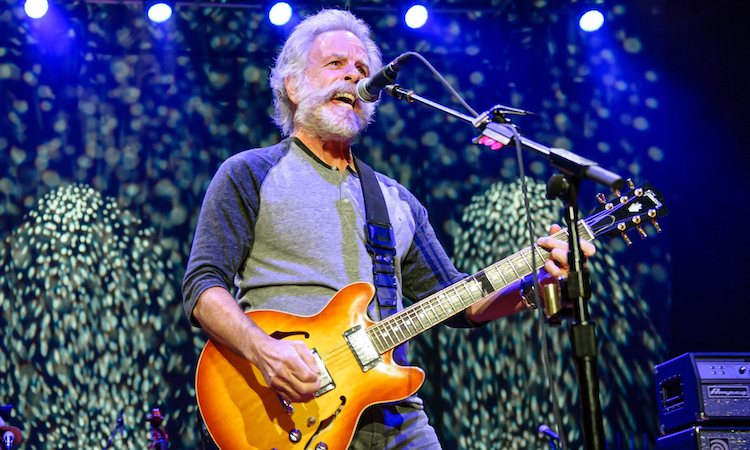
Bob Weir, whose rhythm guitar stylings helped shape the sound of the Grateful Dead, died on January 10, from underlying lung issues after fighting cancer. The announcement was made in a statement on his social media accounts: “For over sixty years, Bobby took to the road. A guitarist, vocalist, storyteller, and founding member of the Grateful Dead. Bobby will forever be a guiding force whose unique artistry reshaped American music. His work did more than fill rooms with music; it was warm sunlight that filled the soul, building a community, a language, and a feeling of family that generations of fans carry with them. Every chord he played, every word he sang was an integral part of the stories he wove. There was an invitation: to feel, to question, to wander, and to belong.”
Weir’s musical journey started out on New Year’s Eve in 1963. Ambling down a street in Palo Alto, 16-year-old Bob Weir heard banjo notes wafting out of Dana Morgan’s Music store. Following the sound inside, he found Jerry Garcia preparing to give a lesson. Weir was carrying his guitar with him, and, reflecting on that moment he said, “We sat down and started jamming and had a great old rave . . . we played a little and decided to start a jug band.”
Not long after meeting up, Weir and Garcia—along with bassist Phil Lesh, keyboardist Ron “Pigpen” McKernan, and drummer Bill Kreutzmann—formed Mother McCree’s Uptown Jug Champions. By 1965, adding rock and roll to the jug band sound, the group became known as the Warlocks for a brief time before Garcia discovered the phrase “grateful dead” in an Egyptian book of magic prayer, and in 1967 the Grateful Dead released their self-titled debut album.
Out of those moments of synchronicity emerged visionary approaches to music that might open with traditional melody lines or hooks from folk, blues, country, jug band, or rock, but would spin off into expansive sonic journeys exploring both the far reaches of the music and expanding the consciousness of the listeners.
Bob Weir’s steady rhythm guitar looped under and around Garcia’s lead guitar noodlings, providing both thematic direction and inventive counterpoint to Garcia’s riffs. Weir brought a wide range of musical influences to the group from rockabilly to cowboy songs. While most of the time Weir was happy to strum in support of Garcia, he stepped into the spotlight effortlessly. As a singer, his rousing whoops and yells fueled many of the band’s songs, driving them into high octane rockers. At the same time, he could capture a shuffling rhythm on tracks like “Sugar Magnolia” and “Truckin’.” The band played over 2,300 concerts and sold over 35 million albums, prior to Garcia’s death in 1995.
In 1972, Weir released a solo album, Ace, even though it was in many ways a Grateful Dead record because most of the rest of band played on it. The album included a number of songs—“Looks Like Rain,” “Mexicali Blues,” “One More Saturday Night,” among others—that would become standards on later Grateful Dead albums and in their shows. As a songwriter, he often worked with John Perry Barlow and Robert Hunter. Weir often talked about songs as living organisms that were protoplasmic, taking new shapes even as they were played in jams on stage.
After Garcia’s death, Weir kept the band’s music alive while also exploring his own musical interests in groups such as RatDog (Weir’s solo band), the Other Ones (later known as the Dead), Further, Bobby Weir & Wolf Bros., which featured legendary bassist and producer Don Was, and Dead & Company, which ceased touring in 2023 but gathered again for two residencies at the Sphere in Las Vegas in 2024 and 2025.
Weir has been honored for his work with a lifetime achievement award from the Grammys, and he and the band have been inducted into the Rock and Roll Hall of Fame and received honors from the Kennedy Center.
Bob Weir’s enduring contributions to our music will continue to deliver the warmth and soulfulness that he brought to his own playing, singing, and songwriting. Thanks to his genius, we’ll always have “one more Saturday night” in which the music washes over us.
“Hell In a Bucket” (JFK Stadium, Philadelphia, PA July 7, 1989)
“Me and My Uncle” (Hampton Coliseum Hampton, VA, March 20, 1986)
“Playing in the Band”
“Greatest Story Ever Told”
“One More Saturday Night”
“Looks Like Rain”
“Sugar Magnolia”